



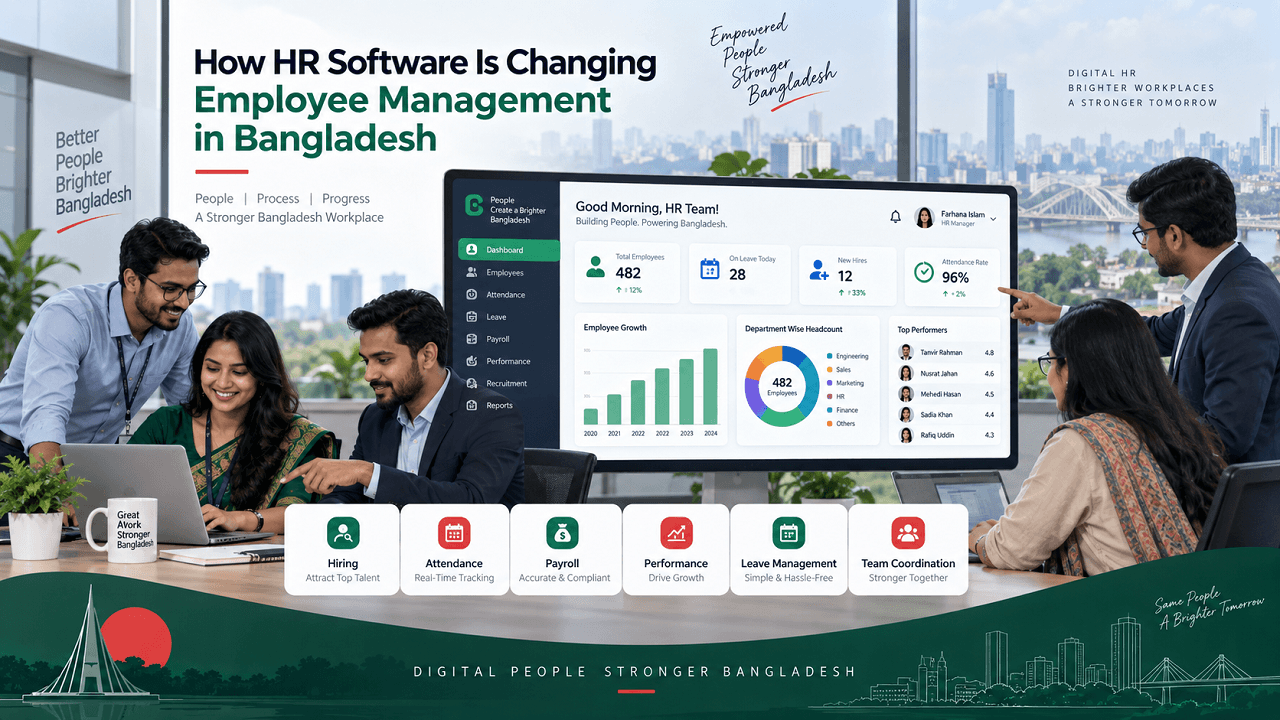
How HR software is changing employee management in Bangladesh is a question more business owners are asking as their teams grow past the point where a notebook and a spreadsheet can keep up. For a long time, HR work in many Bangladeshi companies has meant paper attendance registers, a separate leave file, and salary sheets pieced together by hand each month. That setup can work for ten or fifteen employees. Add a second shift, a new branch office, or a sudden spike in hiring, and the cracks start to show fast.
More companies are now turning to HR Software to pull these pieces into one place. Attendance, leave requests, employee records, and salary calculations no longer have to live in five different files that someone updates separately. Nobody expects a system to fix every HR headache on its own. What changes is more basic than that — where information sits, and how quickly someone can actually find it.
From Manual HR Work to Digital Employee Management
Paper and spreadsheets aren’t inherently broken. They don’t scale well. A register works fine until someone forgets to sign it. A leave spreadsheet works until two people update it at the same time and one version overwrites the other.
Small mismatches like these pile up. A late attendance entry throws off a leave calculation two weeks later. A missed update means payroll gets built on numbers that were already outdated by the time anyone looked at them. None of this is really anyone’s fault—it happens when the same employee’s information lives in four unrelated places.
Centralizing Employee Information
HRIS Software in Bangladesh addresses this fairly directly by keeping employee records, job history, contact details, and attendance and leave data under one roof.
Need to check when someone joined, how many leave days they have left, or which department they moved to last year? That’s a lookup instead of a search through old folders. It won’t stop every data-entry mistake. It does mean HR staff spend less time rebuilding information that technically already exists somewhere in the building.
Better Attendance and Leave Management
Attendance and leave tend to be the first things businesses digitize, probably because they’re the most repetitive. A digital system logs check-ins, tracks leave balances automatically, and sends approval requests straight to a manager’s phone or inbox instead of a paper slip sitting on a desk.
Employees can usually check their own attendance record or remaining leave without stopping by the HR office to ask. For a manager overseeing a retail team across a few outlets, or a production floor running multiple shifts, a real-time view of who’s in and who’s on leave makes day-to-day scheduling far less of a guessing game.
How Payroll Software Is Changing Salary Management
Payroll is where much of the manual HR work happens, and it’s where Payroll Software tends to make the most noticeable difference. Instead of someone manually pulling attendance sheets, calculating overtime by hand, and applying deductions line by line, a connected system draws attendance data straight into the payroll calculation.
That doesn’t mean payroll becomes error-proof — it isn’t, and no software claims that honestly. What changes is how much repetitive re-entry disappears from the process, and how much easier it becomes to catch a discrepancy before salaries go out, since attendance and payroll pull from the same source instead of two separate ones.
Employee Self-Service and HR Reporting
Self-service portals let employees check their attendance, leave balance, or salary slip without sending an email and waiting for a reply. Small requests that used to interrupt HR staff several times a day no longer do.
On the reporting side, a digital HR system can pull together attendance patterns, leave usage across departments, or payroll history over several months into something readable. Reports don’t make decisions on their own. They do give HR teams and department heads something more solid to work from than memory or a half-updated spreadsheet from three months ago.
What to Consider When Choosing HR Software
Businesses comparing HR Software in Bangladesh tend to look at a similar set of things before deciding:
- How employee records and attendance are handled together
- Whether leave approvals follow a clear workflow
- How closely payroll connects to attendance data
- Employee self-service access
- Mobile access for staff who aren’t at a desk all day
- Data security and role-based permissions
- Room to grow as headcount increases
- Local support during setup and onboarding
None of these matter much on their own. A system that nails attendance but ignores payroll integration moves the manual work elsewhere.
The Role of HRIS and Payroll Integration
Much of the practical value comes from integration, not any single standout feature. When HRIS Software in Bangladesh and Payroll Software in Bangladesh run as two separate, disconnected tools, someone is still stuck manually moving numbers from one to the other every month.
Platforms such as Jibika Plexus show what it looks like when HR, attendance, leave, and payroll sit inside one connected system rather than being managed as four separate processes. That doesn’t erase HR work. It does cut down on the part of the job that’s really just copying the same figures from one spreadsheet into another.
Frequently Asked Questions
Is HR software only useful for large companies?
Not really. Even a business with twenty or thirty employees can end up spending a surprising amount of time on manual attendance and leave tracking. The benefit often shows up earlier than most business owners expect, not only once a company reaches a certain size.
Does payroll software eliminate the need for someone to review salaries manually?
No. It reduces the manual re-entry involved in pulling attendance data into salary calculations, but someone still needs to review the output before payroll goes out. Software supports the process — it doesn’t replace oversight.
What’s the difference between HR software and an HRIS?
The terms overlap quite a bit in everyday use. Generally, an HRIS refers more specifically to the system that stores and organizes employee records. At the same time, “HR software” is a broader term that can include attendance, leave, payroll, and reporting tools built around that data.
Final Verdict
How HR software is changing employee management in Bangladesh really comes down to fewer disconnected tools and information that’s easy to find when someone needs it. Attendance, leave, employee records, and payroll can pull from the same data instead of living in separate files that someone has to reconcile by hand.
It won’t solve every HR challenge a growing business runs into — nothing does that. It offers a more manageable starting point, where HR teams spend less time chasing down information and more time using it.